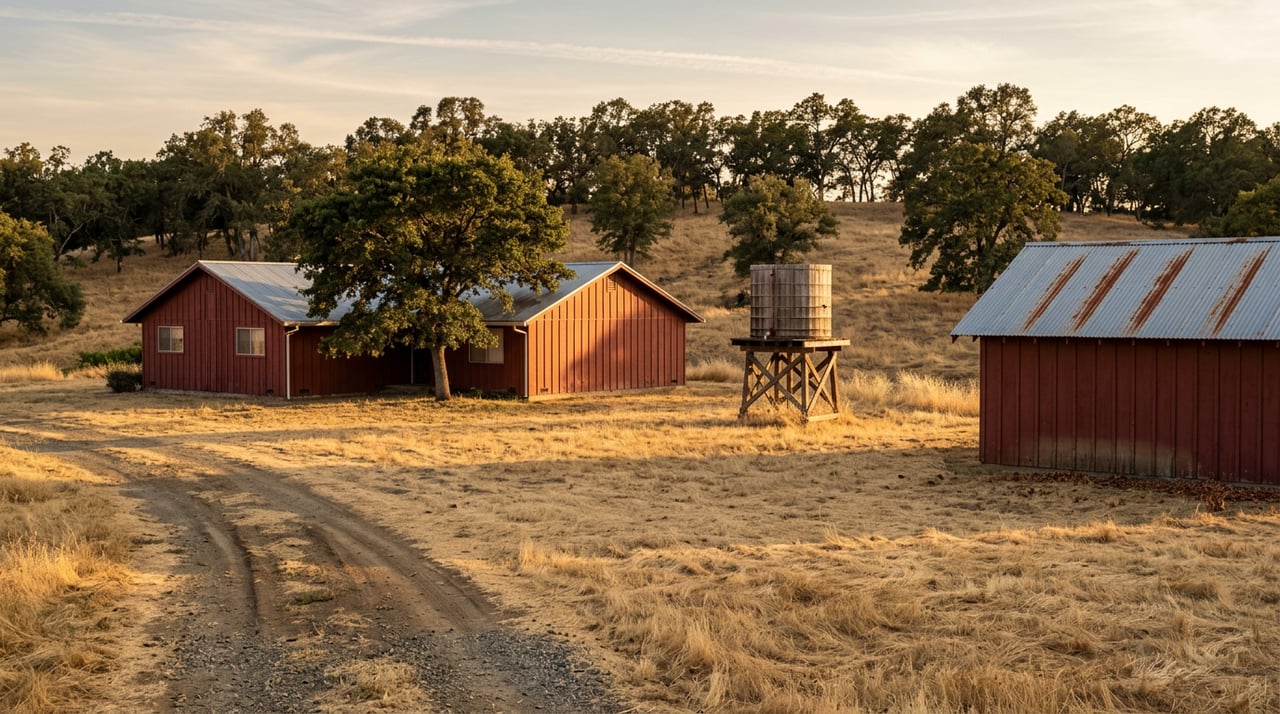
Every year, a buyer finds ten acres outside San Miguel priced at a fraction of what similar ground sells for on Paso Robles' west side and assumes they've found the wine country deal everyone else missed. The soil looks the same. The rainfall is the same. The distance to downtown Paso Robles is a fifteen-minute drive. So why does the price per acre sometimes run at a quarter of what west-side land commands?
The answer has almost nothing to do with dirt quality or curb appeal. It comes down to water, and to a sewer plant most buyers never think to ask about.
What the numbers actually show
Current listings across San Miguel put the average land price near $1 million, with per-acre pricing averaging around $12,500. Compare that to vineyard ground on Paso Robles' limestone-rich west side, long considered the appellation's premium tier, where recent land sales have carried median prices near $2.75 million. Industry pricing guidance for the broader Paso Robles AVA consistently groups San Miguel with Shandon, East Paso, and Creston at the lower end of the region's per-acre value range, not because the fruit is worse, but because of what sits beneath the surface.
Home sales tell a similar story. Local sales data for April 2026 showed only ten homes changing hands in San Miguel that month, with prices spanning from the mid-$500,000s to more than $3 million. That range is wide for a town this size, and it reflects a market built from two very different housing stocks: small historic homes clustered near the old town site around Mission San Miguel, and large ranch or agricultural parcels scattered across the surrounding countryside. Countywide value trackers have put the typical San Miguel home just under $600,000, up less than one percent over the prior year, a sign of a market that moves in small waves rather than broad swings.
Why the gap between east and west is a policy story, not a soil story
Recent land sale analysis across Paso Robles wine country shows a market that splits along Highway 101. West-side properties with existing wells, established water rights, and working improvements have held value through recent cycles, with median land prices near $2.75 million and well-positioned parcels often selling in under 30 days. Land on the region's flatter east side, the pricing tier San Miguel is grouped into, tells a different story. Median prices there have run closer to $800,000, and the softness concentrates specifically in bare acreage and vineyard ground without a documented water position.
That divide traces back to the Paso Robles Groundwater Basin, which restricts new plantings and additional water use unless a buyer can secure an offset. A parcel with vested, pre-restriction water rights carries real value. The same acreage without that documentation is effectively capped in what it can become, no matter how good the soil looks on paper. Add in a statewide grape oversupply, California's 2024 crush dropped 25 percent from the prior year to its lowest level in nearly three decades, and the incentive for anyone to pay a west-side premium for unproven acreage mostly disappears. Improved ranch properties with homes on either side of the highway have kept selling well, with medians above $2.5 million and some sales clearing $3.5 million to $5 million. It's the raw, unproven land where the discount lives.
The infrastructure story most buyers miss entirely
Here's the part that rarely comes up in a listing description. San Miguel's in-town growth has its own separate ceiling, and it runs through a sewer plant.
The Machado Wastewater Treatment Facility, owned and operated by the San Miguel Community Services District, has been treating the town's wastewater since 1944 without a major upgrade since 1999. Its permitted capacity is 200,000 gallons a day, and the district's own environmental review documented the plant already running close to that ceiling, treating an average of roughly 170,000 gallons daily. That left very little room to absorb new development.
The San Luis Obispo County Planning Commission approved a fix in July 2025: a $54 million expansion that will more than double the facility's permitted capacity, from 200,000 to at least 500,000 gallons per day, sized to meet state-mandated 30-year growth projections. General Manager Kelly Dodds told local reporters the district wanted state grant funding locked in before breaking ground, so the burden of financing the project wouldn't fall entirely on existing ratepayers. As of late 2025, the district expected construction to begin in early 2026, but first had to dredge two treatment ponds that had collected sludge for nearly two decades, a cleanup effort that was still working through its contractor bidding process at that time.
None of this changes the price of a vineyard parcel out in the hills. But it matters enormously for anyone eyeing a lot inside the town's service area, because a sewer system running near its ceiling is not a system that can support much new residential density until the expansion is finished and the backlog is cleared.
What this means depending on what you're actually buying
The mistake buyers make is treating "San Miguel land" as one category. It isn't.
| Property type | What sets the price | What to verify before buying |
|---|---|---|
| In-town historic home near Mission San Miguel | Access to Community Services District water and sewer | Current sewer capacity status and any connection fees tied to the expansion |
| Surrounding ranch or ag acreage on well and septic | Independent water source, not municipal capacity | Well yield history, septic system age, and whether water rights are documented and vested |
| Bare or vineyard-ready land east of Highway 101 | Groundwater basin restrictions on new plantings | Whether the parcel has an established, offset-eligible water position under basin rules |
| Improved ranch property with an existing residence | Working infrastructure plus livable improvements | Same water and septic checks, but priced against comparable improved sales rather than bare land |
A buyer chasing the cheapest per-acre number on paper, without checking which of these four categories a property falls into, can end up owning land that costs less today because it's capped in what it can legally become tomorrow. That's not a bad outcome for someone who wants a quiet ranch and has no plans to expand plantings or add structures. It's a serious problem for someone assuming the discount is temporary.
A few questions worth asking before you make an offer
Does San Miguel's land discount mean the area is undervalued? Not necessarily. Some of the gap reflects genuine constraints, water rights status and groundwater basin rules, that a buyer can't simply plant or build their way around. Treat the lower price as a reflection of limited upside on unproven parcels, not as a market inefficiency waiting to correct.
Will the wastewater plant expansion raise home values in town? It's reasonable to expect that added sewer capacity removes a real bottleneck on future in-town development, but the project was tied to a pond dredging process that had to happen before construction could start, and the district's own timeline pointed to a multi-year build. Any effect on values will show up gradually, not overnight.
Does the groundwater basin restriction apply to every parcel in San Miguel? No. It applies specifically to new plantings and additional water use within the Paso Robles Groundwater Basin, and the impact depends on whether a given parcel already has documented, vested water rights. This is exactly the kind of detail worth confirming with title records before writing an offer, not after.
If you're weighing a parcel in San Miguel against comparable ground on Paso Robles' west side, the numbers alone won't tell you which one is the better buy. The water rights, the septic and well history, and the sewer district's own growth timeline will. Home & Ranch SIR has been sorting through exactly this kind of Central Coast ranch and vineyard math since the 1980s. Get Your Instant Home Valuation to see where your own property fits into this shifting picture.
